
Ownership makes or breaks the build vs buy question. The appeal of building AI internally is easy to understand. It promises control and suggests the kind of competitive differentiation that off-the-shelf platforms cannot deliver. For leadership teams under pressure to move quickly on AI, building feels decisive.
For a small number of organizations with the right engineering maturity and data infrastructure already in place, it can work, but for most, the challenge is not building the system. It is owning everything that comes after.
The GenAI Divide: State of AI in Business 2025, MIT, which covered more than 300 deployments and 150 executive interviews, found that just five percent of generative AI pilots achieved meaningful revenue acceleration. The gap between pilot and production almost always comes down to the hidden cost of ownership rather than the technology itself.

The pattern across every major study points in the same direction. Organizations are investing at speed and building with confidence, then discovering that the cost of ownership extends far beyond the initial build in ways they never accounted for.
The bill that was never budgeted for
Elaine Barsoom spent four years as Nike’s Global Head of Tech Innovation Partnerships, where she built and scaled the company’s first AI Center of Excellence across product, retail, marketing and HR. Her perspective on the build vs buy question comes from having lived it at one of the world’s most visible brands.
On a recent episode of the In Other Words podcast, she said:
“When you build, you own every decision the software touches. The governance, the compliance, the workflows that grow around it, and the people maintaining it years later without the context of why it was built that way.”
That last point is the one most leadership teams underestimate. The initial build has a budget and a timeline. But two years later, the architect who designed the system has moved on and regulation has changed underneath it.
The workflows across the organization have hardened around something that technically runs but no longer serves what the business needs. The people left maintaining it are operating without the context of why the original decisions were made. Every adjustment carries the risk of breaking something nobody fully understands anymore.
Most leadership teams plan carefully for what they are building. Almost none plan for what maintaining it will cost them. That is the gap where organizational debt accumulates quietly until it becomes impossible to ignore.
You bought automation. What you need is coordination.
There is a second dimension to the build vs buy question that gets even less attention. It concerns what organizations are really trying to solve when they make a platform decision.
Elaine described a platform her team brought into Nike that was designed to scale innovation programs and measure ROI on ideation. The capability was impressive, but nobody used it.
When her team investigated, they discovered they had bought a solution to a problem that didn’t exist in the way they had assumed. The organization had never mapped out how innovation decisions were actually made, who owned them, or how ideas moved from submission to action. They had brought automation to a workflow that wasn’t there.
“Most leaders think they’re buying automation. What they’re actually trying to buy is coordination. How do we get teams to work from the same system instead of stitching things together manually?”
– Elaine Barsoom, former Nike AI innovation lead.
An organization that builds or buys technology and sees no change in how people operate has added a layer on top of whatever was already not working. What a good platform decision delivers is a shared operating system that removes the fragmentation underneath. It gets teams working from the same foundation rather than reconciling differences once the work is already done.
The ownership question most leaders skip
Phrase CEO Georg Ell, writing in Forbes, has made a similar argument about the hidden weight of internal builds. He argues that most organizations fall into the trap of treating internal engineering as effectively free while overlooking what it actually costs to maintain, govern and scale those systems over time.

Speaking at SlatorCon London 2026 alongside Tripadvisor’s Director of Localization Riccardo Cocco, Georg described himself as “firmly on the side of builders” but argued that companies need to think carefully about what is genuinely worth building internally and what already exists in the market.
Too many organizations, he said, fall into a “sunk cost fallacy,” assuming that internal engineering resources are effectively free while overlooking the long-term costs of maintenance, governance, and scalability.
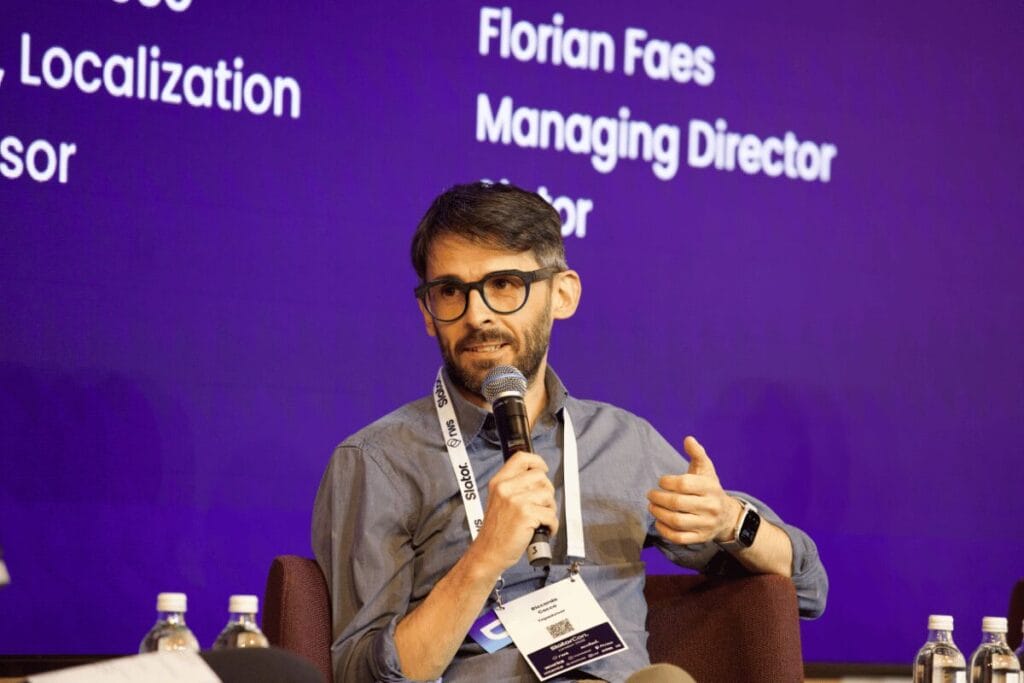
Riccardo put it more bluntly:
“You focus on selling the best travel package to your customers. You don’t build the planes.”
– Riccardo Cocco, Director of Localization, TripAdvisor
The most successful platforms create a shared operating foundation that allows teams to move faster together. That is a challenge Phrase works with global organizations to solve every day.
Zendesk, which operates in more than 160 countries and supports close to 31 languages, partnered with Phrase to replace manual localization processes that had no visibility and couldn’t scale with the company’s growth.
The result was a 96 percent reduction in project analysis time and a 25 percent reduction in translation costs, with full control over translation memory and quality across every market. That was possible because the coordination was designed into the system rather than managed around it.
That is the difference between a platform that changes how people work and one that simply gives them something else to maintain.
Forever wasn’t in the budget
Every major study of enterprise AI failure points to the same conclusion. The technology is rarely what fails. The organizational work of defining what success means, governing what gets built and managing change is almost always where initiatives lose their way.
That finding reinforces what both Elaine and Georg have observed from very different vantage points. The organizational willingness to change around the technology is almost always the determining factor. The organizations getting the build vs buy decision right are the ones asking a different set of questions before they commit.
Where does ownership create genuine advantage and where does it create obligation that the organization is not equipped to carry? What would it mean to design the capability around what the business actually needs rather than around whatever technology happens to be available?
AI success is no longer measured by ownership of systems but by the ability to deliver value reliably at scale. That principle applies whether the system handles engineering productivity or customer experience.
It applies equally to the language and content infrastructure that determines how a global brand shows up across every market it operates in. The organizations that have understood this are compounding their advantage.
The ones still treating the build decision as a technology call are budgeting for the build and hoping that forever takes care of itself.
Discover more
Elaine Barsoom, former Nike AI innovation lead and Venture Partner at Silicon Foundry, examines the decisions that define how global brands scale technology, manage partnerships and embed AI into everyday operations.


