
There’s a particular kind of meeting that happens in every company with international ambitions. Someone from marketing presents results from a campaign, a product launch, or a customer experience initiative that performed well in the home market and underperformed everywhere else. The diagnosis is often the same: the translation wasn’t quite right. The tone was off. The message didn’t land. So the team commits to fixing the translation process and moves on.
Yet six months later, the same meeting happens again.
This is not a translation quality problem. It’s a multilingual brand consistency problem, and it starts much earlier in the pipeline than most organisations realise.
The volume no one planned for
The amount of content a global enterprise produces today would have been unrecognisable five years ago. AI-assisted content creation has accelerated output across marketing, product, support, and legal teams simultaneously. Enterprise content volumes have grown by roughly 30% year on year (Bluente, 2025 Enterprise Content and AI Translation Benchmark Report). That content is created by more people, in more formats, for more markets, than any existing translation infrastructure was designed to absorb. And increasingly, the content pipeline includes not just human teams aided by AI but autonomous workflows: AI agents that draft, adapt, and publish content with minimal human involvement at each step.
And it all needs to sound like the same company when it arrives.
This is the part that’s breaking. AI has made the raw act of translation faster and cheaper. But speed and cost are not the same as quality, and quality is not the same as brand consistency across markets.
Everyone can translate now.
The harder question is whether what comes out the other side still sounds like your brand, uses your terminology, and respects the cultural context of the market it’s landing in. For most organisations, the honest answer is: inconsistently, at best.
Terminology drifts between departments. Brand voice that sounds authoritative in English comes across as stiff in Portuguese or vague in Japanese. Product interfaces use one set of terms; the marketing site uses another; support documentation contradicts both. Industry surveys consistently find that enterprises report more quality incidents, not fewer, after introducing AI translation into their workflows. The AI may have been fast. What it was given to work with, and what nobody checked on the way out, was the problem.
The harder question is whether what comes out the other side still sounds like your brand, uses your terminology, and respects the cultural context of the market it’s landing in.
The irony of going global
There’s an irony at the heart of international expansion that rarely makes it into strategy decks: the more markets a company enters, the harder it becomes to sound like itself.
With international expansion remaining a strategic priority for C-suite executives worldwide for the third consecutive year, and target markets becoming more diversified than ever (Forvis Mazars C-Suite Barometer 2026, n=3,012 executives across 40 countries), the pressure on brand consistency across markets will only intensify. More markets means more content, more adaptation, and more opportunities for the brand to fracture between what was intended and what arrives.
The instinct is to treat this as a problem that lives in one department (if the department exists at all). In practice, it’s an infrastructure question that touches every function with international exposure. The CMO sees brand voice fracturing across markets. The COO sees inconsistency in how the company presents itself from one region to the next. The CPO sees product experiences that don’t quite match from one locale to another. And the CFO sees rising content costs without proportional returns from new geographies.
Analyst firm CSA Research has consistently found that consumers are significantly more likely to buy when information is presented in their own language, and that language availability can matter to them more than price. The commercial stakes are real. The organisational response is, in most cases, still catching up.

What the leaders are doing differently
The most interesting shift is philosophical, not technological.
The organisations that communicate most effectively across borders have stopped thinking about translation as a process to optimise, and started treating language as infrastructure to invest in. Netflix treats dubbing, subtitling, and cultural adaptation as core to its product. The company built an entire language operation because it recognised that a badly dubbed film loses the audience, regardless of how good the original was. When Airbnb expanded into Japan and China, it adapted the full host and guest experience for each market, because trust is built in a user’s own language and cultural frame, and listing descriptions alone would never carry that. Spotify, operating in over 180 markets, curates editorial and playlist content locally rather than simply translating a global template.
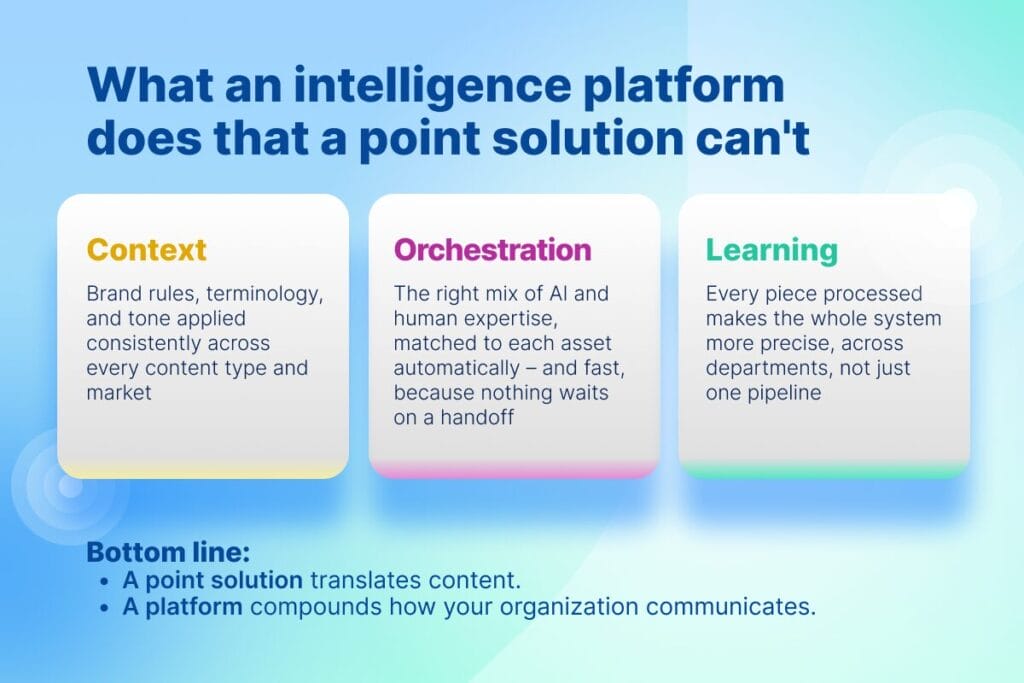
In practice, this philosophical shift shows up in three connected capabilities.
- The first is context that travels with content. Brand rules, terminology, audience-specific tone, and cultural adaptation logic embedded in the pipeline rather than applied manually after the fact. When a company’s style guide, glossary, and market-specific preferences are part of the system rather than a PDF someone emails around, every piece of content starts from a stronger position.
- The second is intelligent orchestration. A system that matches the right combination of AI, human expertise, and quality evaluation to each piece of content and its intent, rather than routing everything through one engine. A legal disclaimer needs different treatment from a marketing headline, which needs different treatment from an in-app notification. The organisations getting this right have built systems that know when AI alone is sufficient and when human judgment matters – and can route accordingly.
- The third is more subtle, but it changes the economics over time: systems that learn. Where the thousandth piece of content processed is handled with greater precision than the first, because the organisation’s language capability genuinely matures with use. Translation memories get richer. Terminology becomes more consistent. Quality evaluation gets sharper. The system does not just maintain standards over time – it raises them. Every piece of content processed makes the next one better. The investment compounds.
These three things – context, orchestration, and learning – are what distinguish a platform from a point solution. A point solution translates. A platform governs how an organisation communicates across every language, market, and content type, and gets better at it over time. That is the shift that the most internationally mature companies are making, and it is the reason the category itself is being redefined.
A category in transformation
This is visible at the industry level. Forrester published its inaugural evaluation of the language technology market in Q3 2025, the first time the analyst firm had assessed this space as a standalone category. The language being used across the industry is shifting: “language technology” in place of “translation management,” reflecting a broadening of what enterprises now need from these systems and who across the organisation they serve. It’s a shift, from workflow tooling to enterprise infrastructure.
And that infrastructure is already being reshaped by a second shift. The platforms being built to govern language across markets will increasingly need to serve AI agents just as effectively as they serve human teams. As agentic workflows become standard in enterprise operations – creating content, requesting translations, publishing across channels – the platform that governs how an organisation communicates can no longer assume a human is always in the loop. It needs to provide the same context, terminology, and brand logic to an agent as it does to a marketer or a translator. The infrastructure must be as legible to machines as it is to people.
Phrase is leading this movement. We’ve reworked and restructured our people, processes and product our into a Language Intelligence Platform; a choice driven less by marketing ambition than by a growing mismatch between what our customers needed and what the old category described. We are not alone in rethinking the boundaries; across the industry, the conversation is moving from “how do we translate faster” to “how do we make language a governed, intelligent layer of how we operate globally.” The terminology will settle over time. The direction is clear.
A question worth asking earlier
There is a pattern in how businesses approach international growth. The investment goes into market entry strategy, local teams, regional marketing. Language gets addressed downstream, often as a procurement decision rather than an infrastructure one. By the time the gaps in brand consistency become visible to customers, they’re already structural.
The companies that avoid this tend to ask a different question early: is our content built to travel, and do we have the infrastructure to ensure it arrives intact?
It sounds simple. But for any business operating across languages and markets, it may be the most consequential infrastructure decision that nobody is yet treating as one.


