
YouTube and gaming now reach Gen Alpha more than twice as often as social media. Two-thirds watch YouTube regularly, more than half are active gamers, and just 22% use social media at all. This is a generation projected to command $5.46 trillion in economic influence by 2029, and they are growing up on platforms that most enterprise content strategies don’t even acknowledge.
For businesses still optimizing for websites, apps, and email, the challenge is bigger than adopting another channel. It is understanding how brand discovery is changing, and whether the organization is built for where customers now spend their time.
YouTube and gaming beat social media by more than two to one
Gaming and video are becoming Gen Alpha’s primary discovery engines, the places where brand preferences and purchase intent begin. And their attention has to be earned. PwC research found that 52% abandon an app out of boredom and 47% leave because of excessive ads. This is an audience that will walk away the moment an experience feels irrelevant.
Gen Alpha platform usage in 2026

Cathy Hackl, CEO of Future Dynamics and Nokia’s Futurist-in-Residence, has been watching this evolve from inside the platforms themselves. She built Walmart Land on Roblox, a branded experience that drew 2 million visits in just three days. She has also worked extensively with Roblox’s global creator community, which now operates across dozens of countries and languages. On the In Other Words podcast, she says
“If you ask a kid, hey, you want 20 Robux, you want $20, if they’re really into gaming, they’re gonna want the Robux because it means more to them than going to Target and buying some clothes. Understanding what they assign value to is the starting point.”
For most boardrooms, it’s a starting point they haven’t reached yet.
Gaming is simply the clearest example of a broader change. Customers are increasingly discovering brands through platforms, creators, communities, and immersive experiences that sit well beyond a company’s owned digital channels.
Global by design
Unlike a website that a business adapts market by market, these platforms are inherently global from the outset. A kid in Tokyo and a kid in São Paulo can share the same Roblox experience in real time. Roblox reached 112 million daily active users in 2025, and its fastest-growing segment is the 18+ age group, which expanded more than 50% year over year.
These platforms have become more than entertainment. As Cathy observes,
“I definitely see gaming spaces as their new social networks. Gaming spaces as R&D labs for brands and companies to understand where they’re spending their time, where they’re investing their money.”
The creator economy on these platforms is already global and growing fast. Cathy noted that Roblox is now minting more millionaires than YouTube among younger creators, because it’s still early enough that a talented developer in any country can build a massive audience. The talent, the audience, and the revenue are already distributed worldwide. The brands entering these spaces need the capability to deliver consistent experiences wherever those creators and players are.
When content means voice, video, gaming, and spatial
The content these platforms require looks nothing like what most enterprise content operations are built to produce. It is in-world text, voice, interactive UI, spatial environments, community content, video. Each format needs to work across languages and cultures simultaneously.
Most content teams are structured around websites and marketing campaigns. They are rarely equipped for the volume, velocity, and variety of content that gaming and immersive platforms demand. The challenge is operational and experiential at the same time.
Cathy experienced this firsthand when building Walmart Land.
“No one had built something at that scale at that moment in Walmart. And then they’re like, can you produce a concert with three different artists? No one had done three different artists inside of a gaming space at that moment.”
The speed and complexity were unlike anything a traditional enterprise content operation was designed to support.
Gaming is not the only place this is happening. AI assistants are also becoming discovery platforms in their own right, recommending products, answering questions, and shaping purchasing decisions through conversational experiences rather than search results or websites. The number of environments where brands need to communicate is growing.
A 2026 Nielsen report found that 49% of Gen Alpha now name AI chatbots as their best source for entertainment recommendations, ahead of search engines and streaming platforms. Brand discovery is moving to entirely new interfaces, many of which are voice-driven, conversational, and multilingual by default.
An industry bigger than Hollywood
Gaming is now worth more than music and Hollywood combined. When cathy was asked what communication channel global brands are most underutilizing, her answer was direct.
“Gaming. I would say gaming is an underutilized channel.”
The point is not that every company should build a Roblox experience. It is that the platforms shaping the next generation of customers are already global, multilingual, interactive, and continuously evolving.
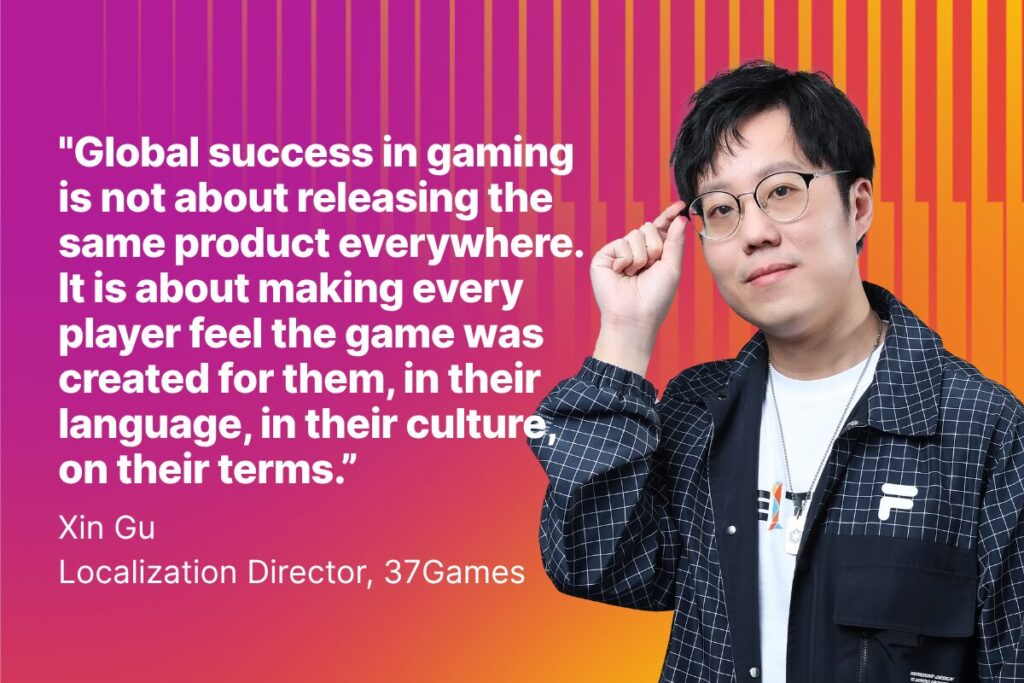
Some companies have already figured this out. 37Games, one of China’s leading gaming publishers listed on the Shenzhen Stock Exchange, operates titles like Puzzles & Survival across 200+ countries and regions. They expanded from 10 to 18 languages, now produce nearly 40 million words annually, and rebuilt their entire content operation to deliver updates at live-service speed.
That scale of operation, 40 million words across 18 languages with continuous live updates, is a realistic example of what a global content infrastructure for gaming looks like. It requires a language intelligence platform that can manage multilingual content across every format, from in-game UI to community content, while maintaining consistency and quality across every market.
The $5.46 trillion question
As Cathy highlights, “It’s moving so fast. I feel like we’re catching up.”
The brands that recognize this and invest in the content infrastructure to match will build loyalty with a generation worth $5.46 trillion before their competitors do.
The platforms shaping the next generation of customers are already global, multilingual, and interactive by design. The question is no longer whether businesses should pay attention. It is whether their content operations are ready for the environments where brand relationships are increasingly formed.
Watch the full conversation
Cathy Hackl is the Godmother of the Metaverse, Global Tech Futurist, Nokia’s Futurist-in-Residence and one of Newsweek’s Top 25 AI Visionaries. On the In Other Words podcast, she shares why brands may soon need to sell to AI agents as well as humans, what a generation thinking in Robux reveals about global commerce, and who owns the digital air around you when computing leaves the screen.


