AI has made content abundant and easier to produce. Credibility has replaced attention as the scarce resource. The organizations that invested in editorial discipline when everyone else was chasing volume are now collecting the dividend.
For more than a decade, content strategy has been a volume game. More formats, more channels, more languages, more posts. AI has accelerated that instinct to the point where any organization can now produce content at scale for a fraction of what it cost two years ago, and the assumption behind the acceleration is that more content creates more opportunity.
The data suggests the opposite is happening. A Gartner survey of more than 1,000 UK consumers found that trust in big brands dropped from 70% to 60% between 2021 and 2025. In a separate study, 68% of consumers frequently question whether the content they encounter is real.
Trust has become the scarce resource, and the organizations that preserved theirs are discovering it is the most valuable investment they ever made.
What happens when nobody believes anything
The paradox in these numbers is that the crisis of trust is creating value for the organizations that maintained their credibility. Research from the Centre for Economic Policy Research found that exposure to AI-driven misinformation reduces overall trust in news but increases engagement and retention with highly trusted sources. Readers who encounter AI-generated misinformation visit credible outlets more frequently and are less likely to cancel subscriptions.
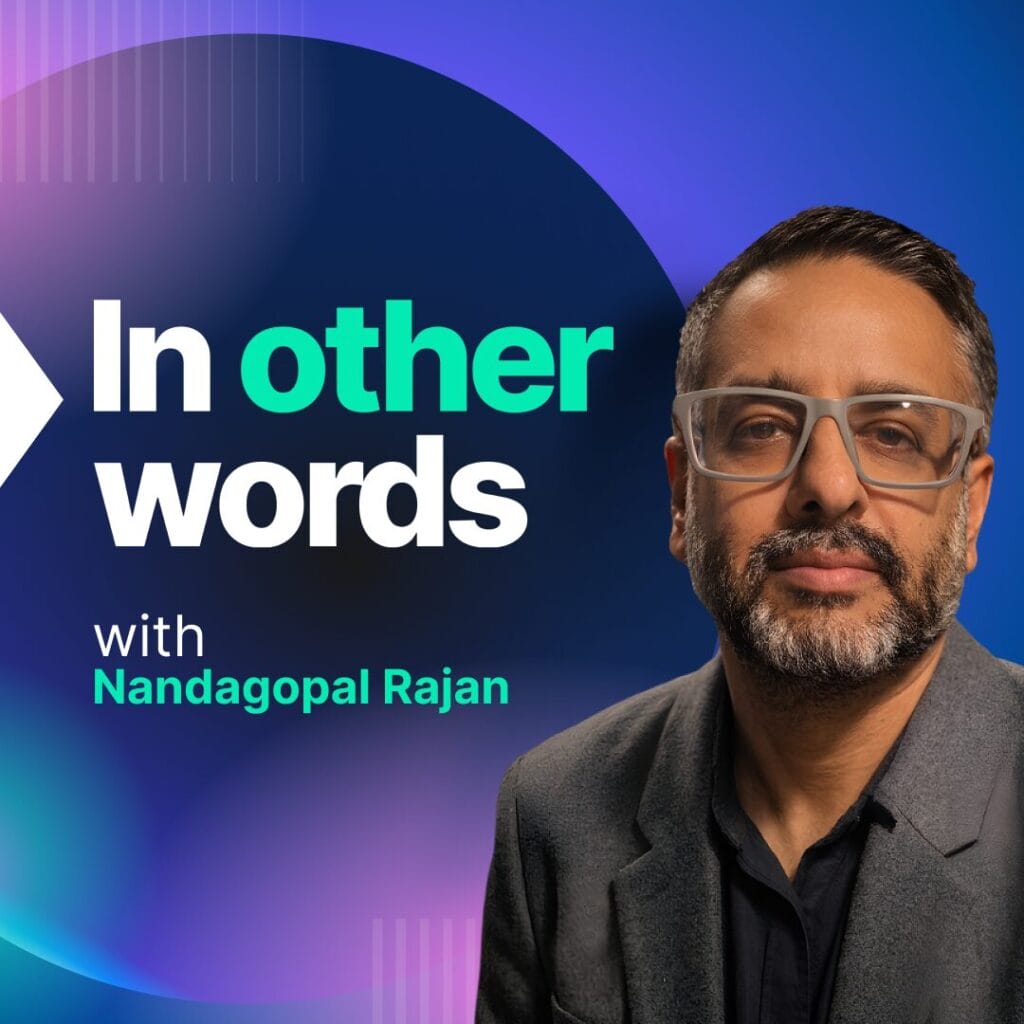
Nandagopal Rajan, CEO of The Indian Express Digital, has watched this dynamic play out across his 100-million-visitor operation. When a series of AI-generated images went viral, including a fake image of the Pope in a puffer jacket, Nandagopal observed that readers immediately went to established outlets to verify the story. On the In Other Words podcast he shared
“AI slop might be the best thing to happen to legacy players. People come back and check whether The Indian Express or the New York Times has reported it. If it hasn’t, maybe they can’t trust it.”
That verification behavior translated directly into commercial results. During a period of military tension between India and Pakistan,The Indian Express committed to publishing only stories that had been double-checked and verified by a reporter, at a time when television networks were broadcasting unverified claims around the clock. The result was a three-to-four-times increase in daily subscriptions, even though none of the crisis coverage was paywalled.
“People were just coming and saying, I want to subscribe to Indian Express because I trust what they’re doing.”
The discipline that machines cannot replicate
Trust at this level is the product of editorial judgment accumulated over years, including the judgment to withhold. Nandagopal highlights
“It’s not just what you publish, it’s also what you don’t publish. We don’t think it’s important enough to be covered. That’s also a matter of trust. Has The Indian Express covered it? No, maybe it’s not worth my time.”
That principle of restraint runs counter to the dominant logic of AI-powered content operations, where the instinct is to produce more because the marginal cost of production has collapsed. Nandagopal is clear-eyed about where that instinct leads.
“The biggest problems newsrooms struggle with is that we have too much content and we don’t have the right audience for it. Solving the problem doesn’t mean you create more content.”
His conclusion is that the organizations best positioned for the AI era are those that can produce content their audiences cannot replicate by asking a chatbot.
“Create journalism that can’t be summarized. That’s what is key to surviving in the AI era.”
The point is not that strong content cannot be summarized. It is that the reporting, judgment, expertise and original insight behind it cannot simply be reproduced by a machine. As content becomes easier to generate, those inputs become more valuable.
The value of knowing what not to publish
The executive temptation is to treat trust as a brand attribute, something that lives in the mission statement rather than in the content workflow. In practice, trust is an operational question about how content is produced and delivered across markets.
AI may have removed many of the limits on how much an organization can create, but that makes the decisions around what should be created and how it should be governed more important.
Jason Hemingway, CMO of Phrase, made a related argument on the AdWeek AI podcast earlier this year. “AI should not be interfering with that trust. It should be used to help build that trust. You’ve got to use it selectively.”

For global organizations, that selectivity has to operate at scale. Every piece of content carries decisions about brand voice, terminology, audience, cultural context, quality and the level of human oversight required. Producing more is easy. Maintaining those decisions consistently across markets is not.
Dr. Eva-Marie Muller-Stuler, founder of The Hummingbird Group, author of Responsible AI Product Development and a Top 10 Most Influential Women in Tech, put it bluntly on the In Other Words podcast.
“If you don’t govern your AI, it doesn’t work. It’s decoration.”
Her argument, drawn from 25 years advising organizations from Fortune 500 companies to the UN and EU Parliament, is that AI changes how decisions are made, and that ungoverned decisions at speed are not efficiency gains but compounding liabilities.
“If you make a wrong decision, you can repeat it many, many times very quickly.”

That operational challenge played out at Deliveroo as the food delivery company expanded across Europe and the Middle East. As the business grew, its content and localization process became fragmented, with engineers and writers across the company sending content for translation through separate, manual workflows. The inconsistency threatened the customer experience that Deliveroo’s brand depended on.
By centralizing its content operation on the Phrase Platform, Deliveroo maintained the consistency that customers in every market had come to expect. Cristina Marin, Senior Localization Manager confirmed
“We’ve helped improve customer satisfaction in new regions.”
The lesson extends beyond localization. When AI increases the amount of content moving through an organization, the value of the control layer around that content increases with it. Businesses need a way to apply the right language, brand standards, quality thresholds and human judgment before content reaches customers. Scale without that discipline can quickly become inconsistency at scale.
When credibility becomes the strategy
Most content leaders are treating AI as a production accelerator without asking what accelerated production does to their credibility. As Amy Abatangle, VP Analyst at Gartner, put it in May 2026,
“Brands are entering a new scarcity, not attention, but trust.”
For any organization producing at scale, the question is whether every piece they publish is building credibility or quietly eroding it. Nandagopal Rajan has seen the answer from both sides over the past decade, and his conclusion is that the discipline to say no and to invest in storytelling that cannot be replicated by a machine is a competitive advantage that compounds over time.
“Storytelling is going to outlast AI. But we have to find that power and bring it into everything that we do.”
AI has made volume easy. Restraint is now the harder and more valuable discipline. The organizations that know when content adds value, and when it does not, will build the credibility that scale alone cannot deliver.
Watch the full conversation
Nandagopal Rajan, CEO of The Indian Express Digital, grew a 30-person basement team into a 550-person operation reaching over 100 million monthly visitors across five languages.
He explains what a decade of building trust in the world’s most complex content market has taught him about editorial discipline, AI adoption, and the monetization paradox facing multilingual publishers.