Over the past few months, Phrase has been travelling. London, Berlin, Madrid, Singapore, and earlier this year, Austin. Across Europe, North America, and APAC, bringing our intimate series of strategic Loc360° events to localization managers, content strategists, product leaders, AI specialists and more. It’s a chance for professionals working in different industries, different company sizes, and at different levels of organizational maturity in how they think about global content.
Across these events, conversations were shaped by practitioners and advisors from companies like Booking.com, Global10x, and a range of high-growth and enterprise organizations.
A clear pattern emerged across all of these sessions; The Localization industry is quietly (and in some cases, not-so-quietly) renegotiating its own identity. What followed were different expressions of the same underlying shift.
We’ve rounded up some of the key points that drove the discussion.
Localization is being redefined as a growth function
The language of “translation as a cost” is giving way to something more commercially grounded. Across every event, teams described a shift from reporting on outputs such as word counts and project completion rates to connecting their work to outcomes that the wider business actually tracks.
In Madrid, Patricia Paladini Adell, digital transformation and change management advisor, framed this as part of a broader shift. Moving from translation as a cost center to global experience as a revenue driver requires a complete rethink of how success is measured and communicated.
The contrast is quite stark. On one side: words translated, cost per word, turnaround time. On the other: markets entered, conversion rates by locale, reduction in support burden, contribution to retention.
That shift is not just semantic. It changes how localization teams position themselves, how they are funded, and how seriously they are taken when decisions are being made.
One example came up repeatedly across sessions. The difference between saying “we translated 150,000 words” and “we enabled entry into three new markets.” Both may describe the same body of work. Only one creates leverage inside the business, and that difference explains why our next theme kept surfacing in conversations.
Claiming a seat at the table is still a fight
Across Berlin and London in particular, teams spoke openly about the challenge of securing a genuinely strategic role in their organizations.
In Berlin, Chris Dell, former Booking.com leader and now Senior Advisor at Nimdzi, addressed this directly. If localization wants to be taken seriously, it has to define its role in the context of the business, not just its own function. That shift in identity is what enables teams to move from support role to strategic partner.

In London, Kevin O’Donnell, Global Growth Advisor at Global10x, extended that thinking further. The question is not whether localization is valuable, but whether that value is being expressed in a way the business can understand and act on.
Internally, localization is still often perceived as operational. Process-driven. Reactive. Something that happens downstream, after the real decisions have already been made.
The gap between how teams see themselves and how they are seen is real. Closing it requires more than better processes. It requires a deliberate shift in how the function communicates its value.
That means aligning with business priorities rather than internal metrics. Speaking in the language of revenue and risk rather than efficiency and volume. Building visibility with senior stakeholders who often do not fully understand what localization makes possible.
What came through clearly in the roundtables is this. A seat at the table is not given. It is claimed, and then reinforced through consistent, measurable impact.
AI is changing the operating model, not just the tooling
AI was a central topic at every event, but the conversation has moved on from fascination with the technology itself. What teams are now grappling with is what AI actually makes possible, and what it makes more complex.
Three patterns stood out.
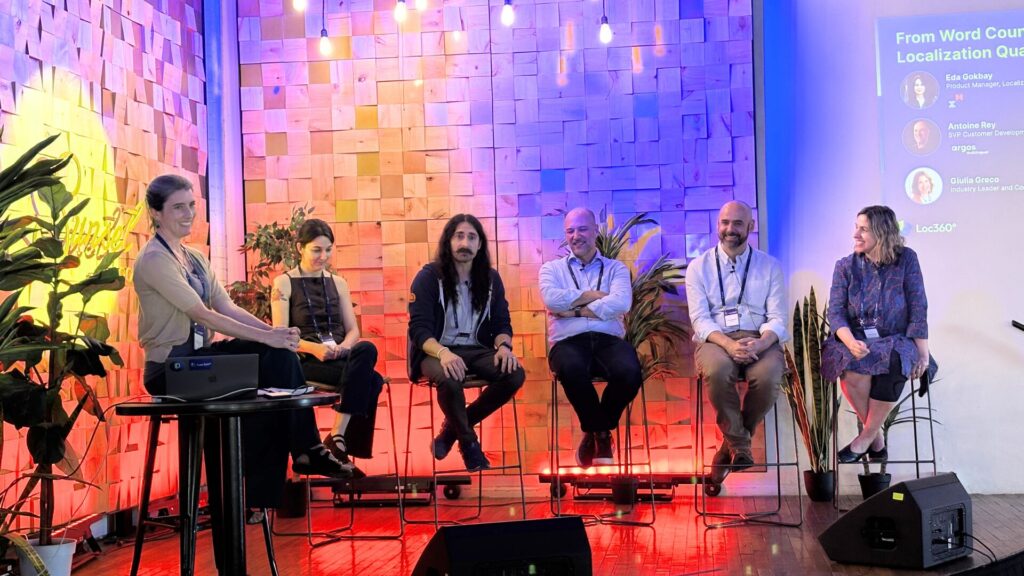
In Austin, Giulia Greco, a localization leader focused on internal influence and data strategy, highlighted how AI is shifting the role from execution to insight. Instead of simply enabling faster output, it is allowing teams to surface patterns across large, previously fragmented datasets and connect their work more directly to business impact.
First, AI is increasingly being used as an analysis layer, not just a production layer. Teams are applying it to identify patterns in support tickets, surface friction in user feedback, and understand content performance across languages. The opportunity is to move from reactive execution to proactive insight.
Second, scale is no longer the primary constraint. The harder question is trust. If you can produce content at ten times the volume, the real challenges become how to measure quality at scale, where human judgment still matters, and what guardrails are needed to maintain consistency.
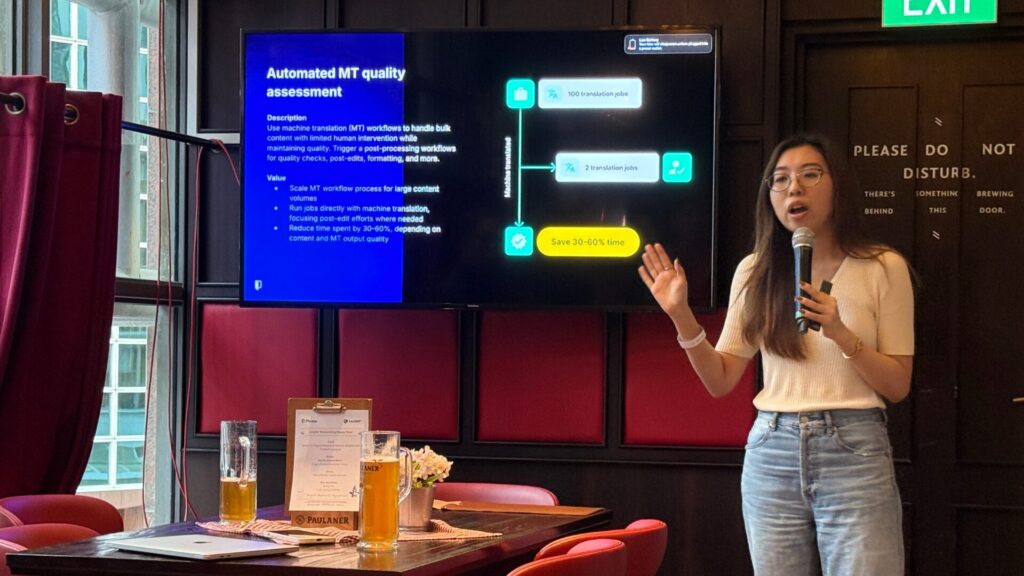
This tension was particularly clear in Singapore, where Bertram Chen, VP Sales APAC at Phrase, and regional attendees focused on how automation and AI are being applied to handle rapidly increasing content volumes across APAC, without losing control over quality, governance, and consistency.
Third, the most grounded teams are not chasing transformation for its own sake. They are starting with one use case, one team, one measurable outcome. Prove it works, then expand. It is a noticeably more practical approach than the sweeping AI narratives that tend to dominate at leadership level, and it is producing better results.
Data is the missing link between effort and impact
If there was one area of genuine consensus across every city, it was this. Most organizations are still struggling to connect their localization work to meaningful business metrics.
The problem is not a lack of data. It is a lack of alignment between data and decisions.
The data that would tell the story is often scattered. Support tickets, user reviews, analytics platforms, regional sales performance. The pieces exist, but they rarely sit in one place, and they are rarely analyzed in a way that links directly to business outcomes.
Some teams are beginning to address this more systematically. Building internal data playbooks. Collaborating more closely with support, product, and marketing. Using AI to surface patterns across large datasets.
The goal is not better reporting for its own sake. It is better decision-making. When a localization team can clearly demonstrate how their work influenced revenue or customer retention in a specific market, they stop being a service provider and start being a strategic partner.
The work is more cross-functional than ever
As the role of global content expands, so does the need for relationships across the business.
One of the most common discussion topics in Madrid, London, and Singapore was ownership. Who is responsible for global content performance? Where does that accountability sit, and where does it break down?
There is no single answer. But a clear pattern emerged.
The most effective teams do not operate in isolation. They build close working relationships with product, marketing, support, and engineering. Sometimes this is formalized through advisory groups or shared KPIs. Sometimes it is driven by consistent, proactive engagement.
Rather than waiting for briefs to land, these teams get involved earlier in the content lifecycle, before decisions have been made that are difficult to reverse. They are not just executing requests. They are shaping outcomes.
A shift that goes beyond localization
Taken together, these conversations point to something bigger than an industry refining its processes.
Localization is in transition. Part operational, part strategic. Part linguistic, part commercial. Part reactive, part predictive. The boundaries between localization, product, marketing, and customer experience are becoming less defined, while expectations continue to rise.
What stood out across every Loc360° event was not just the challenges being discussed, but the level of engagement with them. These are not theoretical conversations. They are live, practical, business-critical questions that organizations are actively working through.
The companies in the room, from global travel platforms and fintech scale-ups to consumer marketplaces and enterprise software brands, are all feeling the same pressure. Move faster. Reach further. Demonstrate clearer impact. And do it in a way that the business can understand and act on.
We will keep having these conversations at future Loc360° events, in new cities and across more regions, with new voices. Not because the answers are settled, but because the questions are becoming impossible to ignore.
Phrase events
Discover our in person events and see first-hand how we’re transforming customer experiences and driving international growth with our latest technologies, innovations and industry insights.