If you ask most localization leaders where their time goes, the answer is rarely translation.
Instead, it disappears into coordination. A question about a workflow change moves from the internal team to a language service provider. That provider points to the language technology platform. The platform provider needs clarification from the service partner. The localization manager becomes the intermediary in a conversation that should have happened directly.
Multiply that across dozens of integrations, thousands of content updates, and an organization that expects global releases to move at the same pace as domestic ones. The coordination overhead begins to look like a structural problem rather than a temporary inconvenience.
That tension formed the starting point for a recent webinar discussion between Personio, Argos Multilingual, and Phrase. The conversation explores what happens when the traditional boundaries between language technology providers and language services providers are loosened. It also explores how outcomes change and when collaboration becomes an intentional part of the operating model.
The result is what the panel describes as a more ecosystem-oriented approach to localization. Rather than forcing internal teams to coordinate between vendors, the vendors themselves share ownership of the solution.
It sounds like a small shift. But in practice it changes how localization operations function day to day.
Watch the full webinar
Watch the full webinar to hear directly from Personio, Argos Multiligual, and Phrase as they discuss how ecosystem collaboration is reshaping localization operations.

Why traditional localization structures create coordination friction
Localization ecosystems have historically been organized around clear boundaries. Technology providers build infrastructure. Language service providers deliver linguistic expertise and operational capacity. Internal teams coordinate between both.
This separation brings advantages. Organizations can select best-of-breed technology and best-of-breed services without locking themselves into a single vendor ecosystem. But the structure also introduces friction, particularly when communication between partners happens through the client rather than directly between the vendors themselves.
Adelina Cristovao, Localization Manager at Personio, described how this dynamic often plays out in practice.
“I was sort of the messenger… I just carry messages from people to people.”
When a problem appeared inside the localization workflow, resolving it meant relaying information between multiple stakeholders.
“I would go to the LSP and tell them this is the problem. Then they would say we need Phrase to do something. Then I would go to Phrase and they would say we need Argos to do something.”
Each step made sense in isolation. But when those steps accumulated across dozens of operational issues, the result was an unexpected role shift.
“And in the end I looked at my week and thought… what did I actually do? I just carried all of these messages.”
For localization teams responsible for scaling global content delivery, this type of operational overhead does more than slow things down. It limits the time available for strategic work such as improving content systems, aligning with product teams, or measuring the business impact of localization.
The question becomes whether the structure itself can evolve.
A shared solutions architect changes the collaboration model
Argos Multilingual and Phrase approach this challenge with a simple but unusual idea. Instead of operating as separate vendors connected only through the client, they jointly fund a shared Solutions Architect responsible for working across both organizations.
The role acts as a connective layer between language technology and language services, enabling direct collaboration between the partners while maintaining separate vendor relationships.
From the client perspective, the appeal was immediate.

“When they told me about the joint Solutions Architect I immediately loved this. It immediately resonated as exactly what we needed.”
– Adelina Cristovao, Localization Manager, Personio
Interestingly, the structure was intentionally flexible from the beginning. Instead of defining rigid responsibilities, the partners allowed the collaboration to evolve around real operational needs.
“The scope wasn’t completely defined,” Adelina recalled. “And actually that was good. As we started working, we all started to get really creative about what it could be.”
That flexibility allowed the collaboration to focus on solving problems rather than enforcing boundaries.
Open communication accelerates operational problem solving
Once the collaboration model was introduced, the most visible change appeared in how teams communicated.
Previously, discussions between vendors often happened indirectly through the client. With the new setup, engineers, project managers, and localization leaders could work together in real time.
“It was just so nice to see Jano and Ali collaborating, working together and communicating to each other what they would need,” Adelina said.
Some of this collaboration happened through something as simple as a shared Slack channel where everyone involved in the workflow could discuss challenges openly.
“It sounds simple,” she said, “but having all of these people in one Slack channel and saying ‘this is what we need’ changed everything.”
This direct collaboration made it possible to implement a new continuous localization workflow for Personio’s high-volume CX content, something that would previously have required weeks of coordination between vendors.
“We had all of this done in one month,” Adelina explained. “And this was a huge thing.”
It also changed how much operational monitoring the internal team needed to perform.
“Before I had to go into Phrase every day to make sure everything was happening. Now if I go two or three times a week, that’s enough.”
The difference was not incremental.
“It saved me days.”
Why collaboration is becoming essential in the AI era
While operational improvements were an immediate benefit, the panel also frames ecosystem collaboration as a response to a much larger industry shift.
Artificial intelligence is accelerating innovation across translation, content creation, and automation. New models and tools appear continuously, which makes it increasingly difficult for any single organization to innovate across the entire localization stack.

Andreu McGurk Lastres, Senior Partnerships Manager at Phrase, described the pace of change with a simple example.
“Things are changing at a pace that is hard to keep up with.”
He pointed to recent experiments with language models.
“Initially OpenAI performed best for localization tasks. Then Gemini started performing better. Tomorrow it might be Claude.”
In this kind of environment, attempting to build or control every part of the ecosystem internally becomes unrealistic.
“None of us can really afford not to be collaborative,” he explained. “Collaboration is now more important than ever.”
Instead, organizations increasingly rely on partnerships where each participant focuses on their core strengths while contributing to a shared outcome.
Explore further
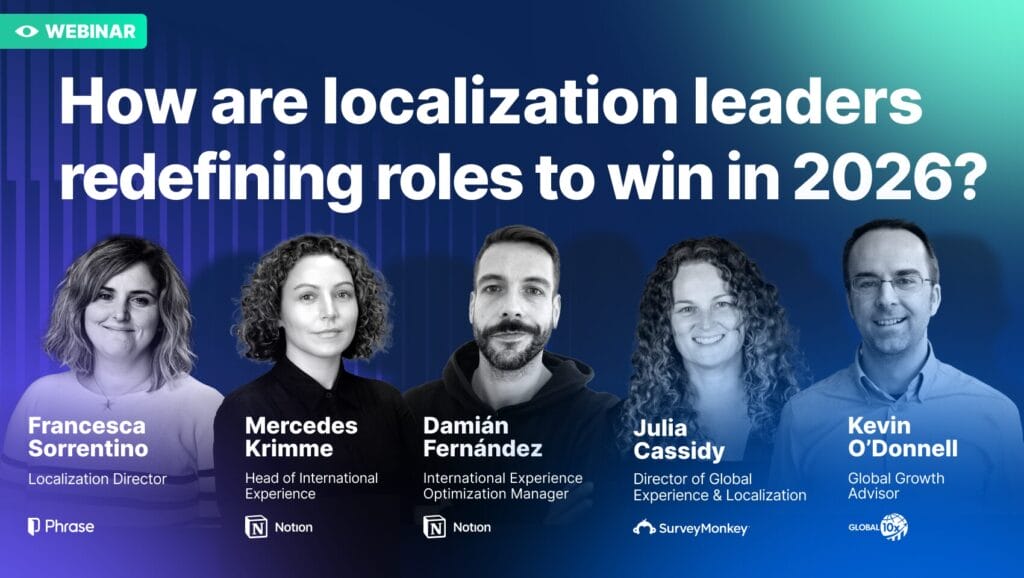
How are localization leaders redefining roles to win in 2026?
Explore how redefining the localization role helps teams move from execution to strategic participation, align more closely with broader business goals, and earn a stronger voice in global decision-making.
Ecosystem partnerships extend the capabilities of localization teams
For many companies, localization teams remain relatively small compared to the scale of the global operations they support.
Personio’s team illustrates this dynamic clearly.
“We’re still a small team,” Adelina explained. “Four people besides me.”
But ecosystem collaboration changes the resource equation dramatically. By working closely with technology and service partners, small internal teams gain access to engineers, linguists, project managers, and solution architects who effectively extend their operational capacity.
“All of the knowledge that exists in these partners… I don’t have that in my team.”
That collective expertise becomes an accessible resource when the collaboration model works well.
“That is a huge wealth of resources and knowledge for me to access.”
This changes the role of the localization leader. Instead of coordinating individual tasks, they orchestrate capabilities across multiple organizations.
“I can bring the logic and the idea of the system, and then together we figure out how it works from the process perspective, from the tech perspective, and from the language quality perspective.”
What this means for organizations building modern localization operations
The discussion between Personio, Argos Multilingual, and Phrase highlights a broader shift in how localization ecosystems are evolving.
For years, organizations faced a binary choice. They could adopt a single vendor that combines technology and services, or they could assemble a flexible network of specialized providers.
Ecosystem partnerships introduce a third option. They preserve the flexibility of independent vendors but create structured collaboration between them.

Antoine Rey, SVP of Customer Development at Argos Multilingual, summarized the principle clearly during the session.
“Collaboration is going to bring further benefits to everyone.”
As global content operations grow more complex and AI continues to reshape how work is performed, this kind of collaboration may become less of an experiment and more of a default operating model.
For localization leaders, that shift offers a practical benefit. Instead of acting as intermediaries between disconnected systems and vendors, they can focus on shaping how global experiences are delivered.
And that might be the most meaningful operational change of all.
Watch the full webinar
Watch the full webinar to hear directly from Personio, Argos Multiligual, and Phrase as they discuss how ecosystem collaboration is reshaping localization operations.