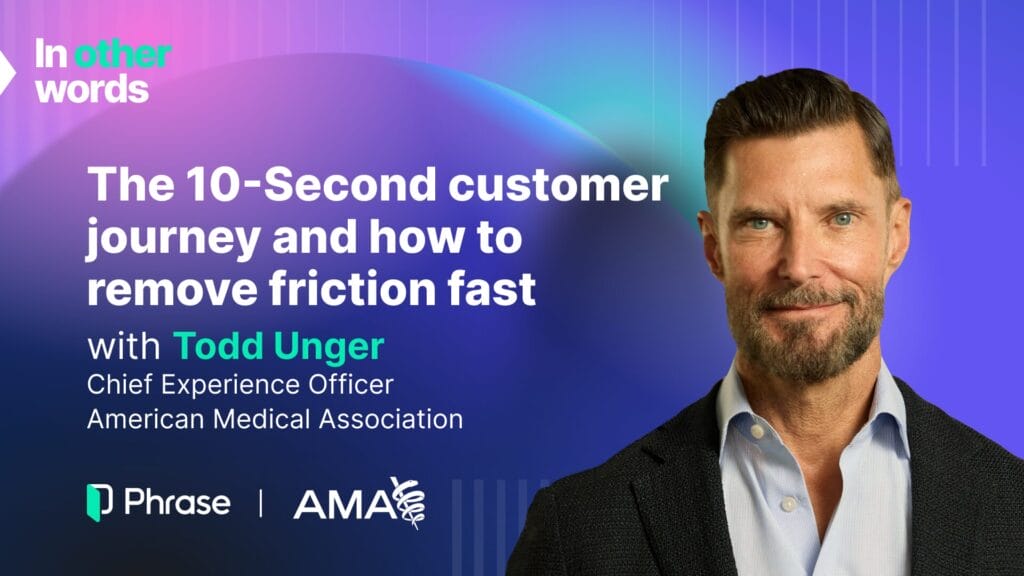
Todd Unger doesn’t describe himself as a traditional customer experience leader. He calls himself an “accidental CXO.” A best-selling author and seasoned transformation executive, his career spans consumer marketing, digital publishing, ecommerce, gaming, and now healthcare, where he serves as Chief Experience Officer at the American Medical Association.
That unconventional path shapes how Todd thinks about growth. Rather than treating marketing, product, commerce, and service as separate disciplines, he sees them as parts of a single system. Customers don’t experience handoffs. They experience outcomes.
In this episode of In Other Words, Todd explains why buying decisions now happen in seconds, how personalization has finally become practical at scale, and why the fastest way to grow is often to remove what gets in the way.
From marketing silos to end-to-end experience
Todd’s CXO role didn’t come with a clear job description. In fact, that ambiguity is what pushed him to define it more precisely.
“Imagine that you had this title Chief Experience Officer, and people just keep asking you, what do you do?”
For Todd, the answer centered on growth rather than surface-level experience design. He deliberately aligned the role with the parts of the organization that shape whether customers can act quickly and confidently.
“When someone experiences a problem in that process, they don’t care about your organizational structure. They just blame the brand.”
That insight sits at the heart of his thinking. Customers don’t see departments. They feel friction when systems don’t work together.
The ten-second decision and the end of linear funnels
Todd’s book, The Ten-Second Customer Journey, starts from a simple observation. Modern buying behavior no longer follows neat, sequential steps.
“I call this ‘The Tornado Funnel’ because it’s so different from the traditional marketing funnels of yesterday.”
Awareness, consideration, and purchase often collapse into a single moment. A product explains itself clearly. The experience feels easy. Payment happens instantly. Or it doesn’t, and the customer moves on.
“You may become aware of a certain thing and instantly like it because they did a good job of explaining it quickly… and if any part of that process fails, you’re on to something else.”
For leaders, this changes the bar. Growth depends on how well every part of the experience works together under pressure.
Personalization finally becomes real
Todd traces today’s personalization capabilities back to ideas that emerged decades ago.
“When I was doing research for the book, I remembered the Peppers and Rogers one-to-one futurefrom the nineties.”
What those early frameworks lacked was infrastructure. Today, behavioral data, automation, and AI make personalized engagement possible in real time.
“That identification of behaviors and interests… combined with the communication tools allow you to start delivering a personalized content experience.”
For Todd, personalization is defined by relevance. It means giving people what they need, when they need it, in a way that feels intuitive rather than invasive. That principle applies across marketing, product, service, and increasingly, across languages and accessibility contexts as organizations grow.
Friction is where growth is quietly lost
If personalization is about adding relevance, friction is about removing obstacles. Todd sees friction everywhere.
“Friction exists at every step of the process.”
He illustrates this with a story from the AMA’s online education platform for resident physicians. Activation rates were low as the process failed to reflect real behavior, despite the content delivering clear value.
“We thought, oh my god. We’ve created a process that’s not going to work.”
Login details were sent long before users needed them. Access broke down outside office hours. Small mismatches compounded into major drop-off.
By rethinking the experience from the user’s perspective and removing key barriers, the impact was significant.
“We immediately increased activation rates by almost half.”
Todd’s takeaway is practical. Don’t try to fix everything. Find the biggest source of friction and start there.
AI as an accelerant, not a shortcut
Todd is optimistic about AI, but measured.
“You don’t have to build this on your own because this is being built into powerful and likely global tool sets.”
At the AMA, AI supports personalization through marketing automation and identifies friction through continuous monitoring.
“It’s basically like twenty-four seven surveillance about where friction is occurring on your site.”
These systems surface issues teams might otherwise miss, from broken buttons to stalled workflows. But Todd is clear that governance matters, especially in regulated environments.
“You really have to think about those things in advance.”
AI creates leverage when it supports better decisions, not when it replaces accountability.
Freshness comes from testing, not reinvention
When asked how organizations stay relevant as they scale, Todd’s answer is direct.
“The number one thing is building a culture of testing in an organization.”
Testing is a discipline of continuous learning.. Even after years in the same role, Todd still sees unexpected results.
“I’ve been here eight years, and we’re still seeing results like this in testing.”
New tools, new data, and new people create opportunities to improve what once felt settled. But testing only works when it’s expected.
“Beyond permission. It has to be an expectation.”
That mindset keeps teams humble and curious, even as systems mature.
Balancing quick wins with long-term growth
Todd doesn’t see short-term results and long-term strategy as competing forces.
Large transformation initiatives rarely get funded. Progress comes from a series of visible improvements.
“I don’t think that they’re at odds….Fixing your email. Optimizing your website. Improving search visibility.”
Over time, those wins compound. What looks incremental becomes structural.
Why the Ten Seconds Decide
Todd Unger’s philosophy threads consistently through his career and this conversation. In a compressed decision window, customers judge clarity, ease, and trust almost instantly. Those ten seconds determine whether they move forward or move on.
Speed carries weight because attention is limited. Relevance earns engagement because customers respond to what reflects their immediate needs. AI contributes when it strengthens visibility, surfaces breakdowns, and enables teams to resolve friction before it costs conversion.
For organizations operating across markets, languages, and regulatory environments, these ideas point toward a common truth. Growth favors companies that align systems, simplify journeys, and make action effortless across every touchpoint.
As Todd puts it, this is “literally the single most exciting time in history” to work in customer experience. The opportunity lies in using new capabilities thoughtfully, staying close to real behavior, and continuously removing the friction that stands between intent and action until those decisive moments consistently convert.
Hear more
If you’ve enjoyed this look at the highlights from the latest episode of In Other Words, you can hear the entire episode now on our website, or subscribe via Spotify, Apple, or wherever you listen to your favorite podcasts.